
WeTheNorth Market
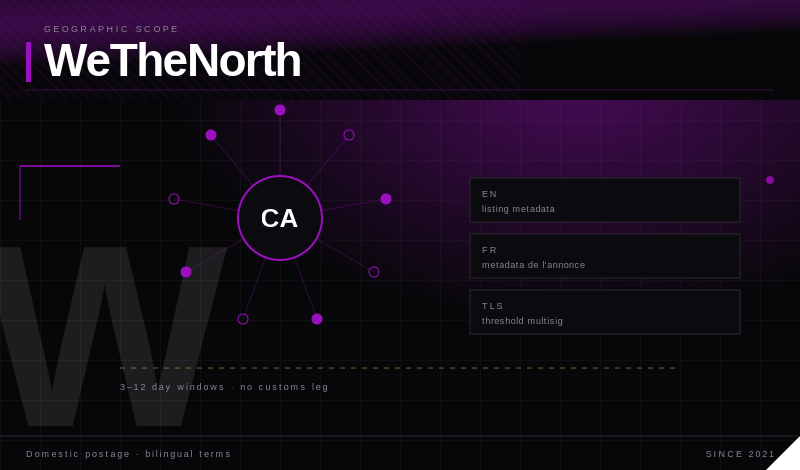
The directory's only geography-first entry and its oldest: a Canada corridor with domestic postal rates, bilingual metadata and a threshold rule that makes multisig the default on anything expensive. The narrowest audience and the most specific catalogue logic here.
Background
WeTheNorth opened in 2021, a year before the Hydra seizure reshaped the field, and survived that transition by not competing on it. Its premise is geographic: a Canadian audience, Canadian vendors, domestic postage, and a catalogue selected for what clears Canadian customs rather than for what looks impressive on a front page.
The interface is bilingual English and French throughout, including listing metadata, and the platform is the only entry here that has been discussed in national broadcast coverage. The audience is small relative to the generalists and unusually stable.
History
The market predates the cohort by a year and carried a modest domestic trade through the 2022 shock, which it absorbed without a migration event. Through 2023 it added French metadata across the catalogue and tiered the bond upward for domestic-only vendors, whose shipping promise is the platform's central claim and therefore the one most worth enforcing.
Canadian coverage in 2023–2024 treated the platform as the domestic cryptomarket and quoted RCMP commentary on cross-border parcel volume beside it. The resulting traffic spike was absorbed by a third mirror.
Design and interface
Server-rendered with progressive enhancement and a full French translation, including category names, shipping tables and dispute terms. The bilingual discipline extends past the chrome: vendors file metadata in both languages or a listing is not promoted.
Translating dispute terms is the part that matters most and the part most platforms skip. A French-speaking buyer reading a French escrow clause is bound by a text they can actually parse, which shifts a measurable share of disputes from interpretation to fact.
Payment and escrow
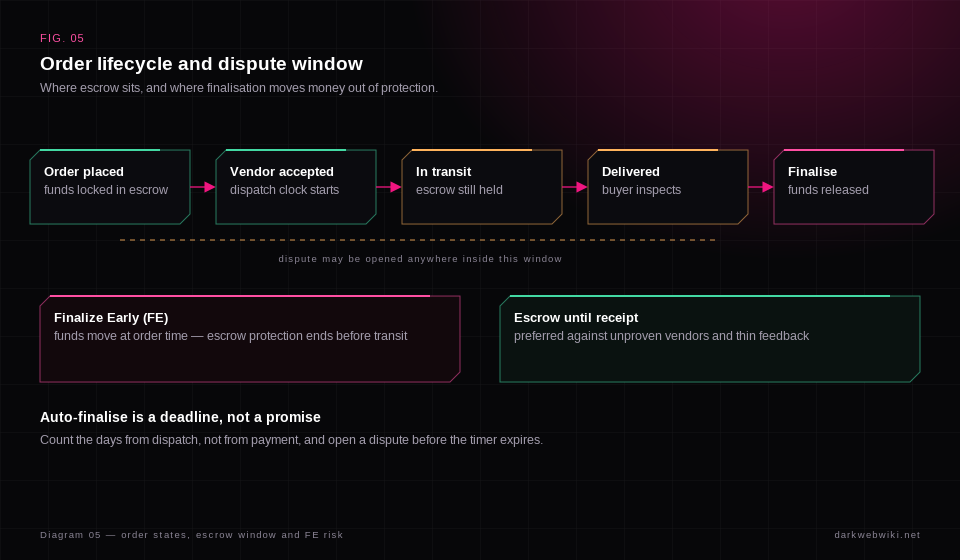
BTC and XMR both settle. 2-of-3 multisig becomes the default above a value threshold; below it, classical escrow applies. Domestic shipping means shorter escrow windows on average — five to twelve days rather than the cohort's seven to twenty-one — because there is no customs leg to wait out.
Shorter windows are a real cost for the buyer: the auto-refund and auto-finalise timers both arrive sooner. Count from dispatch, and open a dispute before the timer, not after. See the escrow reference.
Policy
The bond is tiered and highest for vendors promising domestic-only stock, since that promise is the platform's differentiator and the easiest to fake. Delivery-time claims are logged per vendor and a missed domestic median is grounds for demotion regardless of rating.
The prohibition list follows the Canadian reading rather than the cohort norm: a category legal domestically but routinely caught at the border is treated as out of scope, which is why the catalogue looks narrower than its six categories suggest.
Security model
Two rails, threshold multisig, three mirrors, bilingual terms — a conventional posture with geographic compression. There is no scripting restriction, so the browser attack class stays open; the mirror set is small and canary-pinned.
The distinctive risk here is postal, not digital: a domestic corridor means more orders per unit time and therefore more address exposure per vendor. Pinned vendor keys matter more than usual, since a hijacked vendor account can harvest a dense run of Canadian addresses in hours.
Mirror infrastructure
Three mirrors, selected for latency across Canadian provinces and renumbered in the canary after the 2024 traffic spike. The canonical host is marked and the other two carry issue dates.
Three hosts is a deliberate middle: enough to absorb a routine run, few enough to audit. As everywhere, only hosts present in the current signed canary count.
Reception
Domestic vendors cite the postal rates and the shorter windows as the reason to stay; buyers cite the same windows as the reason to be careful. Coverage in Canadian press has been descriptive rather than investigative, and no dedicated measurement study exists.
For a reference work the entry is valuable as the only geography-first case: it shows that a corridor market's advantages and its timer pressure come from the same physical fact.
Questions
Does WeTheNorth ship outside Canada?
The catalogue is built for the Canadian corridor; cross-border shipping exists but is the exception, not the design.
Is French supported throughout?
Yes, including category names, shipping tables and dispute terms — listings without both languages are not promoted.
Why are escrow windows shorter?
Domestic postage removes the customs leg, so the baseline window is five to twelve days instead of the cohort's seven to twenty-one.
Is multisig optional?
It is the default above a value threshold and classical escrow applies below it.
See also
- CannaExpress — the other narrow-scope entry, by category rather than geography
- Torzon Market — the multi-rail generalist for comparison
- BlackOps Market — where key pinning is enforced rather than recommended