
BlackOps Market
The operational-security archetype of the post-Hydra cohort: one settlement rail, one interface level, one non-negotiable key rule. BlackOps is the entry most often cited when the discussion turns to whether a market can be built without JavaScript — and the one that shows what that decision costs.
Background
BlackOps opened in 2022 into the fragmentation that followed the April seizure of Hydra by Germany's Federal Criminal Police Office. No platform inherited Hydra's volume; instead a dozen mid-size services opened in parallel and competed for a migrating user base that had learned to distrust single points of failure. BlackOps is one of that cohort and shares its defining trait: it was designed by people who had watched the giants fall for reasons that had nothing to do with cryptography.
The market is English-language, oriented to North American and European buyers, and has never widened its settlement rail beyond Monero. That single constraint propagates into almost every other property of the platform — vendor economics, deposit friction, dispute volume — and makes the entry unusually easy to describe in structural terms.
History
The market launched quietly and grew through Dread forum threads rather than paid placement. Early coverage filed it as a general-purpose Western market with a listing policy narrower than its category, and the most-repeated observation from that period concerns the vendor bond: it was raised sharply in 2023, coinciding with a visible drop in freshly registered vendor accounts.
By 2024 the platform was appearing in annual law-enforcement reporting as a representative Monero-only mid-sized market. It has not been the subject of a dedicated longitudinal measurement study comparable to the Carnegie Mellon series that covered the Silk Road–AlphaBay era, so most of what is known about its internals comes from operator statements and user observation rather than instrumented research.
Design and interface
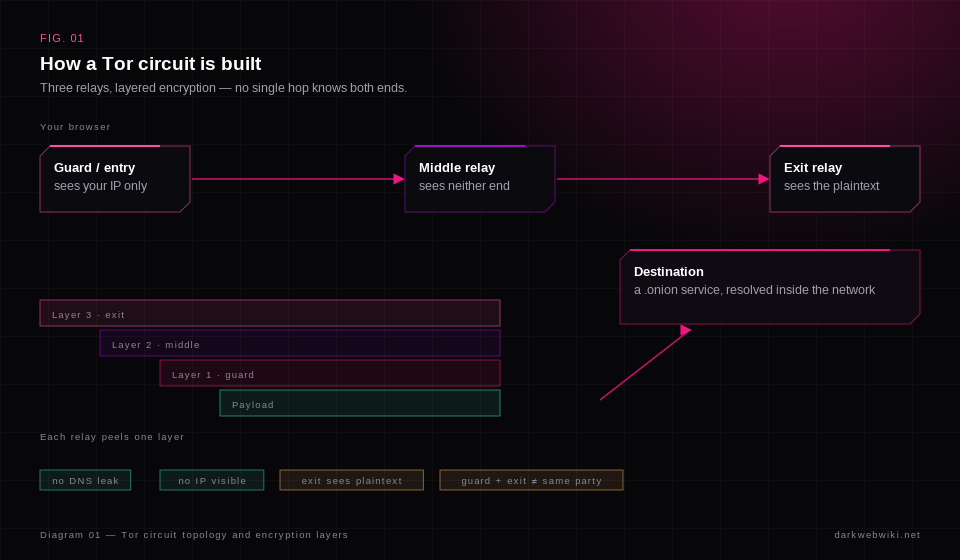
The interface is server-rendered HTML with a hard commitment to not requiring client-side scripting. Pages stay legible and operable at Tor Browser's Safest security level, which disables JavaScript on every site, including hidden services. The Tor Project has recommended that level for years; almost no market honours it.
What the rule buys is the elimination of an entire exploit class — script-driven browser fingerprinting, injected wallet stealers, clipboard hijacks delivered by compromised third-party resources. What it costs is every convenience feature built on the DOM: live price refresh, instant search, drag-and-drop carts. The interface is correspondingly slow to use and correspondingly hard to attack.
Payment and escrow
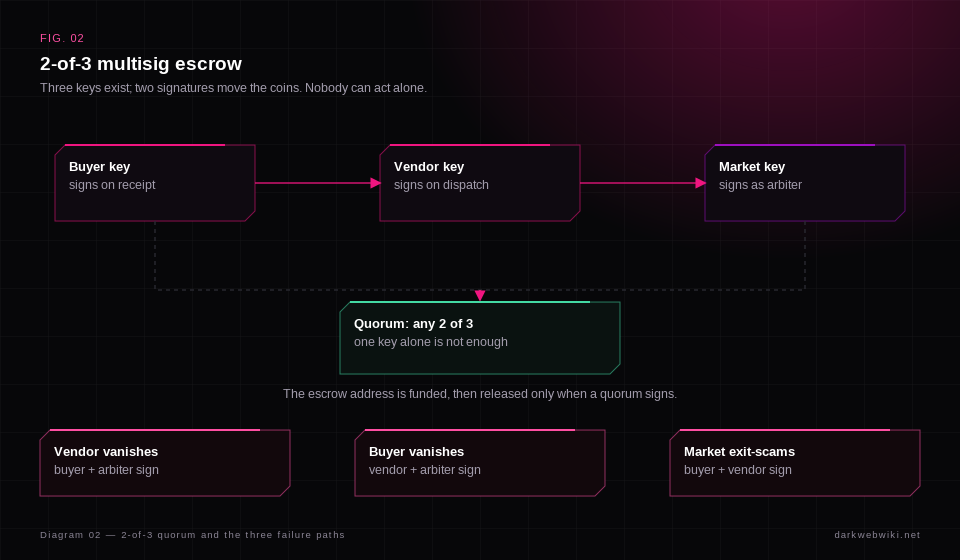
Only Monero is accepted. Deposits go either into classical escrow — the platform holds funds until the buyer finalises — or into a 2-of-3 multisignature wallet in which buyer, vendor and operator each hold a key. The buyer chooses before ordering; the terms page states that multisig orders carry a slightly higher listing fee to offset the key-exchange handshake.
The mechanics of both models, and of the Finalize Early shortcut that removes protection altogether, are set out in the escrow reference. The relevant local detail is that BlackOps funds multisig addresses through a handshake that requires the buyer to stay online through two confirmations; abandoning the tab mid-handshake strands the deposit until the wallet expires.
Vendor policy and listings
Published vendor rules prohibit firearms, services aimed at unaffiliated individuals, counterfeit medical products, and content whose sale is criminal in essentially every jurisdiction. The general scope is therefore broader than the specialty shops in this directory but narrower than a supermarket — the category list is short and the prohibited list is long.
The bond is the enforcement mechanism: it is forfeited on a confirmed scam complaint, and the confirmation threshold is a moderator judgement on signed evidence rather than a buyer vote. Vendors must publish a verified PGP key before the first listing goes live, and — unusually — the key cannot be rotated without going through re-verification. That closes the most common vendor-account takeover path, in which a hijacked account swaps in an attacker key and receives every subsequent shipping address in plaintext.
Security model
Three design choices carry the security posture: no JavaScript, Monero-only settlement, and pinned vendor keys. Each removes a distinct attack class — browser exploits, on-chain clustering, correspondence interception — and each is enforced by the platform rather than recommended to users.
What remains outside the platform's control is the address itself. Vanity prefixes such as blackops… cost a few dollars of computation to generate, so a clone can look convincing in the first twelve characters. The full 56-character hostname has to be compared against the signed canary every time; there is no shorter safe check.
Mirror infrastructure
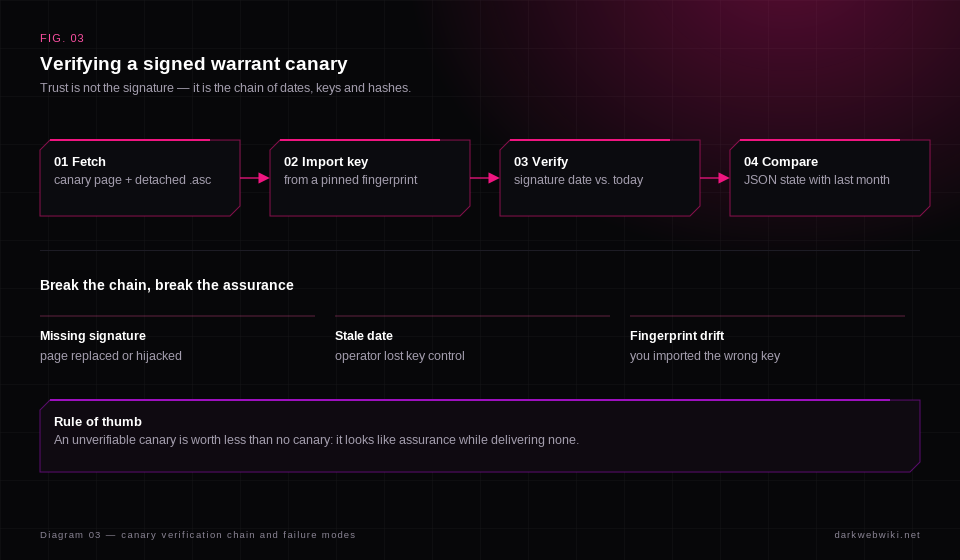
BlackOps runs a small ring of mirror hosts — enough to spread load and absorb a denial-of-service run against any single mirror, few enough that the set stays auditable. The canonical host is reproduced inside the PGP-signed canary, which is the only copy a clone cannot forge.
Because the mirrors are not published here, the practical routine is: obtain the canary from a source you already trust, verify its signature against a pinned fingerprint, read the current canonical host, and compare all 56 characters before entering anything. Mirror lists scraped from search results should be treated as a hypothesis, never as a source.
Reception and research
The market has been named in EUROPOL's Internet Organised Crime Threat Assessment since 2023 and in Chainalysis's Crypto Crime Report series, generally as an example of the Monero-only turn rather than as a subject in itself. Vendor-side commentary tends to split on the no-JavaScript rule: praised by operators who started on 2016-era platforms, criticised by those running high-volume listings where every extra click costs orders.
Its relevance to a reference work is structural. BlackOps is the cleanest available example of a market that chose survivability over throughput and enforced the choice technically, which makes it the natural baseline against which the convenience-oriented entries in this directory can be read.
Questions
Does BlackOps Market accept Bitcoin?
No. Monero is the only settlement rail; deposits in BTC are not credited.
What is a vendor bond?
A deposit vendors stake before listing. On BlackOps it is forfeited when a scam complaint is confirmed by a moderator.
Why does the site require no JavaScript?
So the interface remains operable at Tor Browser's Safest level, which disables scripting and closes the browser-exploit class.
Is 2-of-3 multisig mandatory?
No. It is selectable per order at a slightly higher fee; classical escrow remains the default.
See also
- Torzon Market — the multi-currency convenience contrast
- DrugHub Market — the other Monero-only platform, with the opposite scope strategy
- Omega Market — XMR-native by design rather than by restriction