
DrugHub Market
The structural answer to supermarket sprawl: a metered category list, Monero-only settlement, and moderators who treat a dispute as information rather than as a cost. Small on purpose, and legible because of it.
Background
DrugHub opened in 2023 with an explicit structural thesis rather than a product pitch: the big markets died of their own breadth. Every extra category brings vendors who do not fit the moderator's competence, listings that cannot be compared, and a queue that grows faster than it drains.
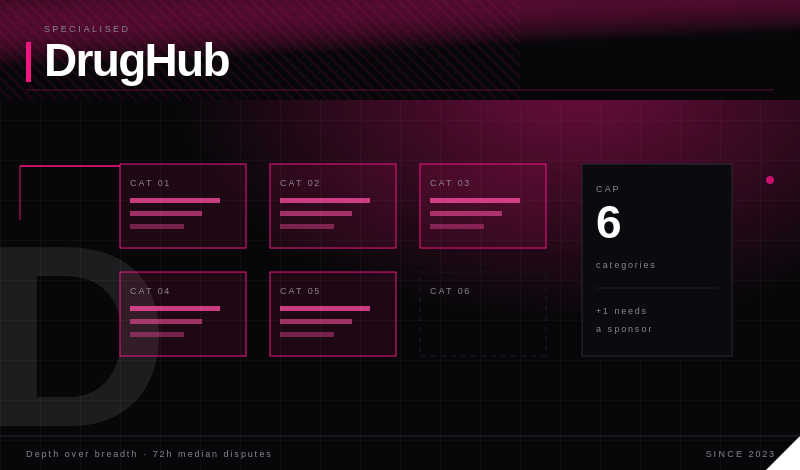
The platform therefore caps its category list. Six categories at launch, and the operator has published that new categories need a sponsor among existing vendors and a stock threshold before opening. It is the only entry in this directory with a documented admission gate for categories themselves.
History
Growth was slow and vendor-led. The first cohort arrived from the specialist sections of larger markets, where their listings had sat unheard under a generalist front page; DrugHub gave each one a category of its own and a stock badge alongside the rating.
Through 2024 the platform held its cap while adding depth inside categories rather than beside them, and became the reference point in vendor arguments about whether a cap is viable at all. It is: the shop survives on repeat orders to a small set of trusted vendors, and its dispute rate is a fraction of the generalists'.
Design and interface
The interface is server-rendered with progressive enhancement — usable at Safest, better with scripting on — and organised almost entirely around categories and vendor history rather than search. Category pages carry stock age and restock cadence, which no generalist exposes.
The consequence is a browsing experience closer to a stocked shelf than a catalogue. A reader who knows what they want finds it in two clicks; a reader who wants to browse gets a small, fully described surface instead of an infinite scroll.
Payment and escrow
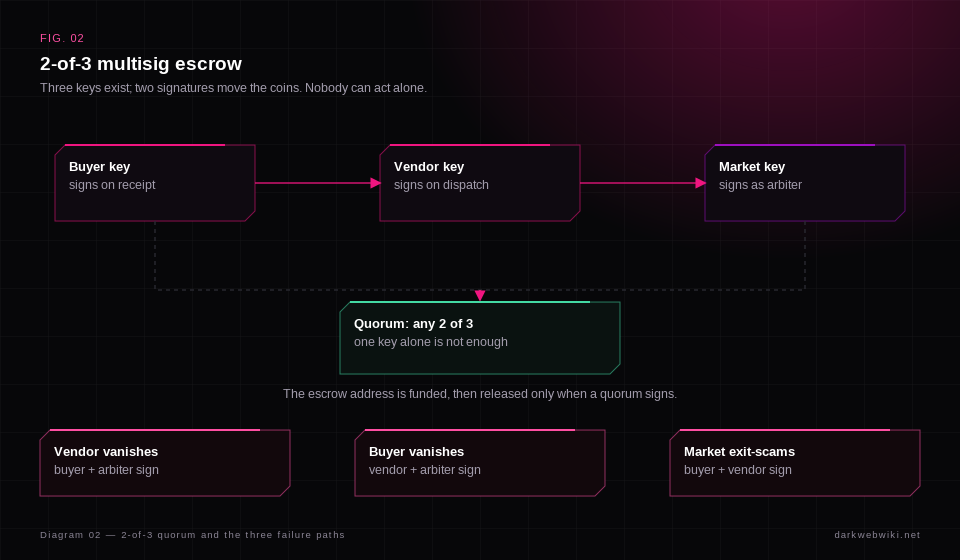
Monero only, with classical escrow as the default across the catalogue. Multisig opens automatically above a value threshold, which is the inverse of the pattern elsewhere — protection is the default on expensive orders rather than an opt-in.
Deposits are per-order and carry two confirmations. See the escrow reference for what the dispute window actually protects and where Finalize Early removes it.
Policy
Vendors must hold a rating above a stated floor before a listing is promoted out of the category tail, and the bond is flat and refundable on a clean exit rather than tiered. The prohibition list is short because the category list is: what is not in a category is out by definition.
Moderators lean toward the buyer in shipment disputes and toward the vendor in description disputes. Published statistics show a majority of disputes closing inside 72 hours, well under the cohort median — a direct product of a category list small enough for two moderators to hold in their heads.
Security model
The posture is procedural rather than technical: Monero-only settlement closes chain analysis, and the capped catalogue closes the moderator-capacity gap that consumes most generalist queues. There is no no-scripting rule, and the mirror set is small — two hosts, both reproduced in the canary.
A small mirror set is a genuine single point of failure under attack, and DrugHub has had outage windows that a larger ring would have absorbed. The trade is that the address surface a buyer must audit is correspondingly tiny.
Mirror infrastructure
Two mirrors, rotated deliberately rather than scaled. Both appear in the signed canary with issue dates; the canonical host is marked. Because the set is small, a mirror list scraped from a forum has a reasonable chance of being complete and a poor chance of being current.
The practical routine is identical to every other entry here and shorter to perform: verify the canary signature, read one of two hosts, compare all 56 characters, then load nothing else.
Reception
Cited in vendor threads as the proof that a cap can work, and in buyer threads as the market with the least wasted time per order. Researchers use it as the counterweight to Torzon in exactly the same argument Torzon is used against BlackOps: is breadth a product feature or an administrative debt?
The honest reading is that DrugHub is small enough that one bad hire in the moderator team would be visible immediately, and that its long-run record is still short of the 2016 incumbents it argues against.
Questions
How many categories does DrugHub carry?
A capped list of six at launch; new categories need a vendor sponsor and a stock threshold.
Is multisig optional?
It opens automatically above a value threshold rather than being chosen per order.
Does DrugHub accept Bitcoin?
No, Monero is the only rail.
How fast are disputes resolved?
Published figures put the majority inside 72 hours, materially faster than the generalist entries.
See also
- BlackOps Market — the other Monero-only entry, with the opposite scope strategy
- CannaExpress — specialisation taken to a single category
- Torzon Market — the uncapped generalist counter-argument