
DarkMatter Market
Kept as a baseline for how a market ends. DarkMatter offered the standard modern feature set — two rails, escrow, multisig — and then stopped, without an exit statement, leaving its canary as the only record of the end.
Background
DarkMatter was a mid-sized generalist of the mid-2020s: BTC and XMR, escrow with a multisig option, a tiered bond and an unremarkable catalogue. Nothing about its structure was distinctive, which is exactly why it is worth an entry — most markets look like this, and most end like this.
It is retained here after closure because a directory of live platforms gives a false sense of the base rate. Roughly one entry in eight being retired is closer to the ecosystem's real shape than a wall of active cards.
History
Opened mid-decade, grew to a stable mid-size vendor cohort, and stopped in 2026. There was no seizure announcement, no Dread post from the operator and no final canary note — the signature simply stopped advancing and the mirrors began timing out.
That pattern is the most common non-dramatic ending: not a coded exit scam and not a bust, but an operator who ran out of either time or money and did not write anything down. Distinguishing it from an exit scam after the fact is often impossible, which is a finding in itself.
Design and interface
Conventional server-rendered interface with enhancement, a standard category tree and a cart. Nothing in the design anticipated difficulty and nothing in it caused any.
Fees were percentage-based and tiered by listing prominence, the arrangement most of the cohort used before flat schedules began to appear. The tiering made cross-vendor price comparison mildly unreliable, since prominence positions were partly purchasable.
Payment and escrow
Both rails settled with escrow as the default and multisig available. Deposit credits required confirmations per rail — two for XMR, one to three for BTC depending on amount.
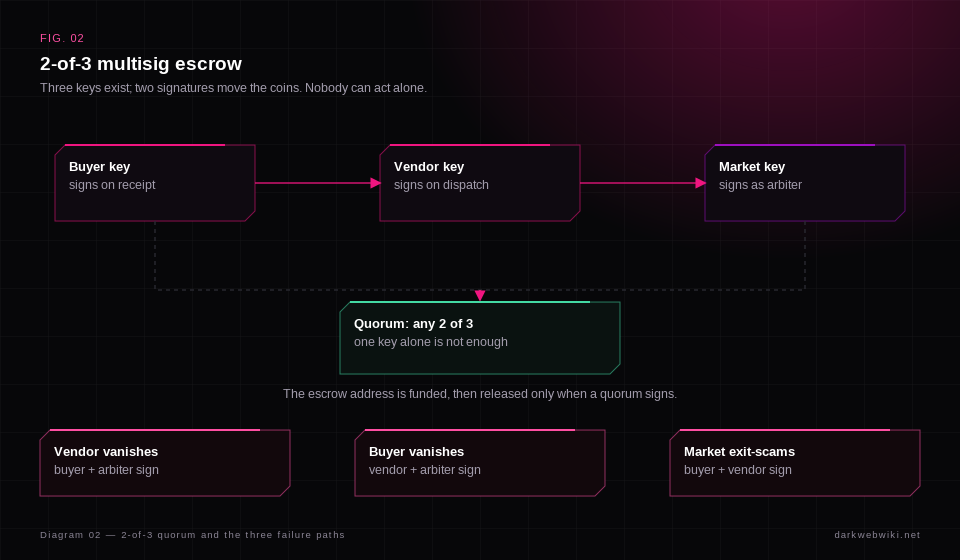
When the platform stopped, escrow balances stopped with it. Buyers holding unfinalised orders had no quorum path, because multisig was opt-in and few had chosen it; the standard escrow account was the operator's alone. The mechanics of that difference sit in the escrow reference.
Policy
Tiered bond, standard prohibition list, dispute queue with two extensions. Moderator response times were unremarkable and are not the reason the platform ended.
The honest lesson in the policy is that none of it mattered at the end. Rules govern trade; they do not govern an operator's decision to stop, unless the rules include a solvency signal — which on DarkMatter, as on most platforms, they did not.
Security model
Two rails, optional multisig, three mirrors, canary on an irregular cadence. Every element is standard, and the standard failures all apply — including the one that actually happened, an operator-side stop with balances still held.
Irregular canary cadence is the one property worth flagging retrospectively: a market whose signature advances without a schedule cannot be checked against a calendar, so a stall is not visible until it is old.
Mirror infrastructure
Three mirrors, now dead. The canary payload survives in archives and still reproduces the last canonical host, which is the only durable artefact an ended market leaves.
For a reader arriving after closure, the address no longer matters, but the shape of the record does: a signed canary with a final date is a cleaner ending than a forum post three weeks later.
Reception
Retrospective discussion is thin and splits between two readings: a quiet wind-down, or a slow exit that was dressed as one. Without a final statement the evidence cannot decide, and the entry should be read as an example of that ambiguity rather than of a conclusion.
Its function in this directory is comparative. Every active entry should be read against it: what would survive if the operator stopped tomorrow, and how quickly would a reader know?
Questions
Is DarkMatter Market still reachable?
No, it stopped in 2026 and the mirrors time out.
Was it an exit scam?
Unknown — there was no exit statement, and a quiet wind-down is indistinguishable from a slow exit without one.
Why keep a retired entry?
A directory of only live platforms misstates the base rate; roughly one in eight entries here is retired.
What is the earliest reliable signal of a closure?
A canary signature that stops advancing, which is why irregular cadence matters.
See also
- The full directory — for the seven active entries
- Escrow & 2-of-3 multisig — why optional quorums protect almost nobody
- About & method — how retired entries are handled