
Escrow and the 2-of-3 quorum
Every darknet market sells the same two things: goods it does not own, and a procedure for when those goods do not arrive. Escrow is the procedure. This page explains both of its implementations, the shortcut that removes it, and the exact points where each one fails.
Classical escrow
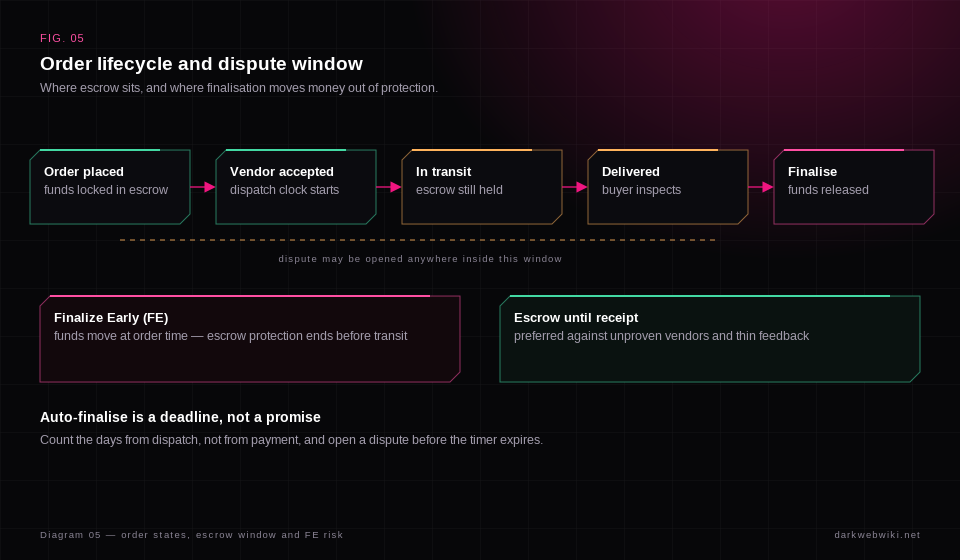
The buyer pays into a wallet the market controls, not the vendor. The market tells the vendor it is safe to ship. The parcel arrives, the buyer inspects it, and only then does the buyer finalise — at which point the funds are released.
Everything that follows on this page is downstream of one asymmetry: before finalisation the buyer holds the leverage, after it the buyer holds nothing. A market cannot undo a finalisation, which is why every rule about escrow exists — windows, arbitration, extension limits — is an attempt to manage the moment where that leverage flips.
The structural weakness is custody. One party holds every balance at once, so a seizure or a voluntary exit takes the whole float. Classical escrow protects the buyer from the vendor and protects nobody from the operator.
2-of-3 multisig
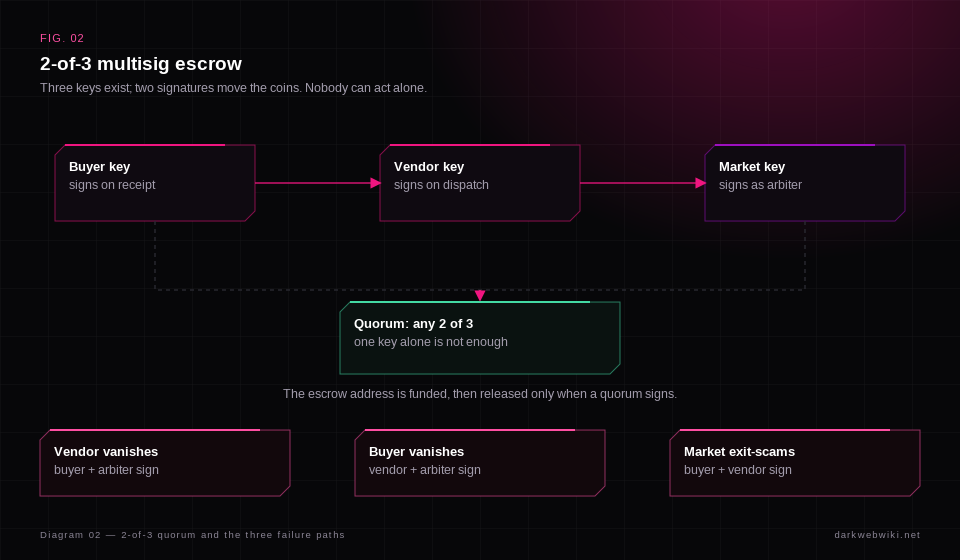
Three keys exist — buyer, vendor, operator — and any two must sign to move coins. No single party can spend, including the operator. In a normal order buyer and vendor sign and the operator's key goes unused.
Three cases are worth naming, because each maps to a different signer pair:
- The vendor vanishes. Buyer and operator sign; the buyer is refunded without the vendor's participation.
- The buyer vanishes. Vendor and operator sign after the window; the vendor is paid.
- The operator exit-scams. Buyer and vendor sign; the balance moves with no operator at all — the only arrangement on this page that survives a hostile market.
The buyer-side key is a real burden. Lose it and the third path closes; the order needs the operator again. Every market offering multisig says so in the terms and almost no buyer reads it, which is the most common way the model degrades into classical escrow with extra steps.
Implementation differs by chain: in Bitcoin it is a script, settled since 2012. In Monero it is a key-exchange handshake between the parties, production-usable only since 2020. Older documentation that treats "multisig" as chain-agnostic is describing the Bitcoin case and quietly wrong about the rest.
Finalize Early
Finalize Early (FE) releases escrow at order time. The vendor receives before shipping; the buyer's leverage is spent at the checkout page. Some vendors offer a discount for it, which is the compensation for giving up the entire protection.
FE is not a scam signal in itself — long-established vendors use it to stop capital sitting idle, and a vendor with three years of history and a stable median delivery time is a reasonable FE counterpart. The failure is applying it to everyone:
History is long and visible
Hundreds of reviews across years, a stable delivery median, and prior escrowed orders you have completed yourself.
The vendor is new
Three weeks of feedback is three weeks of a sample. After FE, a missed parcel leaves only the vendor's goodwill.
The rule that follows is short: never FE a first order. Establish the vendor with one escrowed purchase, then decide. Where a market tags FE vendors, sort them out of the results until you have that history.
Disputes and evidence
A dispute freezes the escrow and puts the order in front of a moderator, who releases to one side or splits. The moderator sees only what is filed, so the quality of the evidence determines the outcome far more than the merits do.
Signed evidence carries weight; unsigned text does not. A PGP-signed message from the vendor, a timestamped shipping screenshot, the listing's own terms — these are checkable. A pasted chat log is trivially forged and moderators discount it accordingly. The practical consequence is to keep correspondence inside the market rather than in a chat app, where nothing is signed.
Two failure modes dominate. On the buyer side, filing a dispute without the tracking number they already have. On the vendor side, arguing that a delay was disclosed in terms that were never attached to the listing. Both are avoidable with one screenshot taken at the right moment.
Resolution times across the directory run from under three days at the capped-catalogue end to a week or more at the generalists. A long queue is not neutral: it disadvantages whichever side was relying on the timer.
Windows and extensions
Escrow windows are set per vendor, usually between 7 and 21 days, shorter on domestic corridors. Buyers can typically extend twice, adding up to two weeks — relevant for intercontinental post. A window that expires unreleased auto-refunds.
Count from dispatch, not from payment, and count the extension allowance before ordering rather than after. Two further details:
- Deposits need confirmations before they credit to escrow — two on Monero rails. A pending deposit is early, not lost, and should not be treated as a payment failure.
- Auto-finalise is a deadline, not a promise. It fires on the timer whether or not anything arrived, so a dispute must be open before it, not after.
Comparing the models
| Property | Classical escrow | 2-of-3 multisig | Finalize Early |
|---|---|---|---|
| Who holds the funds | Operator | Shared address | Vendor, immediately |
| Refund without vendor | Yes, via moderator | Yes, buyer + operator | No |
| Survives operator exit | No | Yes, buyer + vendor | Yes |
| Buyer-side key burden | None | Yes — loss closes a path | None |
| Levers after payment | Full, until finalise | Full, until quorum | None |
| Reasonable for a first order | Yes | Yes | No |
Implementation by market
How each entry in the directory actually runs it, in one line each:
- BlackOps — both models, buyer-selectable per order, XMR only
- Torzon — both models, buyer-selectable, BTC + XMR
- DrugHub — classical default, multisig automatic above a threshold
- WeTheNorth — 2-of-3 above a threshold, short domestic windows
- CannaExpress — classical escrow, multisig on request, shortest windows in the directory
- Catharsis — standard escrow with written response deadlines
- Omega — standard escrow, FE vendors tagged and sortable