
Catharsis Market
The only entry that publishes its own procedural deadlines. Three settlement rails, region-tagged mirrors and a dispute pipeline written down far enough that a moderator can be measured against it — process as the product.
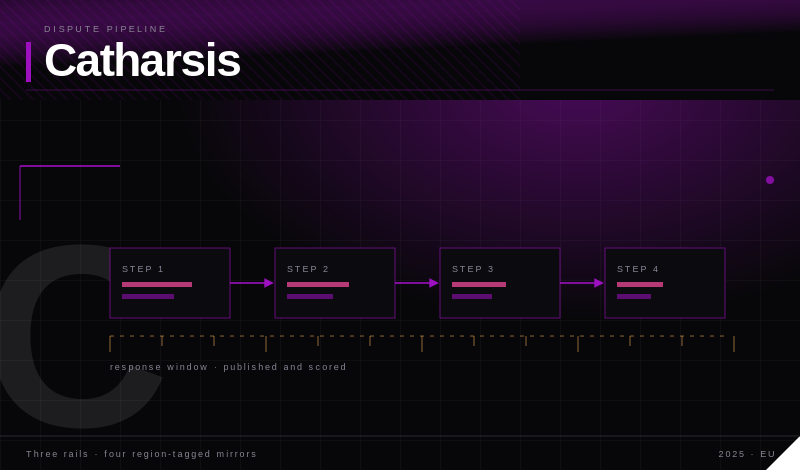
Background
Catharsis opened in 2025 with a procedural thesis: the thing buyers actually want from a market is not inventory but a predictable resolution, and predictability is a document, not a vibe. The platform is EU-corridor by design — three dispatch countries, three interface languages, four region-tagged mirrors.
Three settlement rails coexist, which is otherwise a generalist trait. Here it exists to match domestic payment habits: the rail is chosen by corridor, not by preference, and the listing states which applies.
History
Launched early 2025, the platform published its dispute pipeline before it published its category list — an inversion that produced immediate attention in vendor communities that had spent years in queues without deadlines. The first public revision of the pipeline shortened moderator response windows after vendor complaints that the original forty-eight hours was unenforceable.
Through 2026 it has added a fourth mirror and a German interface localisation. It has not widened beyond the EU corridor, and the operator has stated that it will not until resolution times hold across all three dispatch countries for four consecutive quarters.
Design and interface
Server-rendered with progressive enhancement across three languages. Every listing carries a dispatch country and the rail that applies to it, and the checkout refuses a mismatch rather than warning about one.
The interface's centre of gravity is the order page, not the catalogue: the window, the deadline, the extension controls and the dispute button are all on one screen, with the timers visible rather than buried. It is the only entry here where the dispute path is discoverable without reading a help page.
Payment and escrow
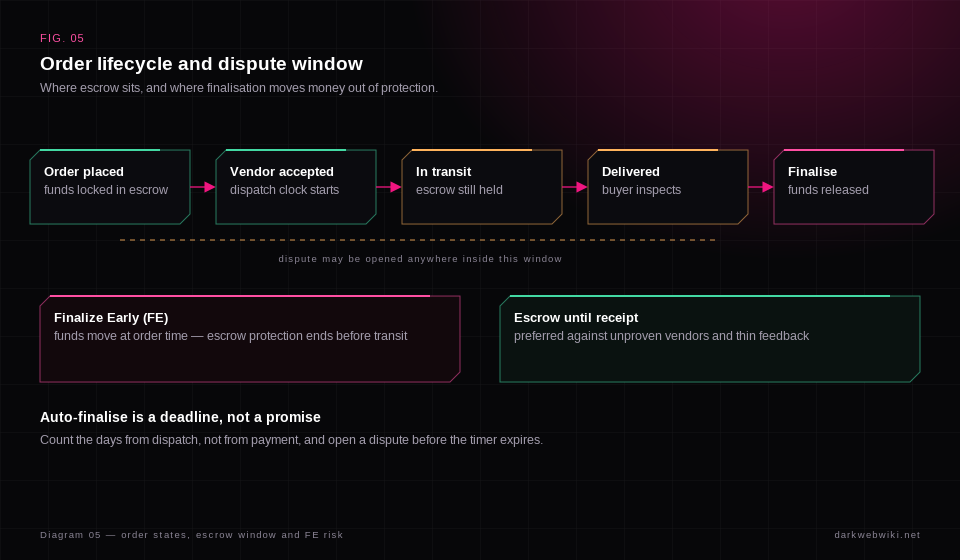
BTC, XMR and LTC settle, but which one applies is a function of the vendor's corridor. Escrow is standard and every order carries a written deadline; extensions are logged and capped at two.
Published deadlines cut against the usual ambiguity: the buyer knows exactly when the auto-finalise timer runs out and when a dispute must be raised, in the listing, before paying. The mechanics that make those timers consequential are in the escrow reference.
Policy
The bond is tiered by dispatch country, higher where the postal service is slower and chargeback pressure greater. Vendors must declare a country and cannot change it without re-listing at the new tier.
The pipeline itself is the policy: written intake, a stated first-response window, a stated evidence format and a stated escalation. Moderators are scored on the first-response window publicly, which is unusual and which is the single most-cited reason vendors tolerate the tiering.
Security model
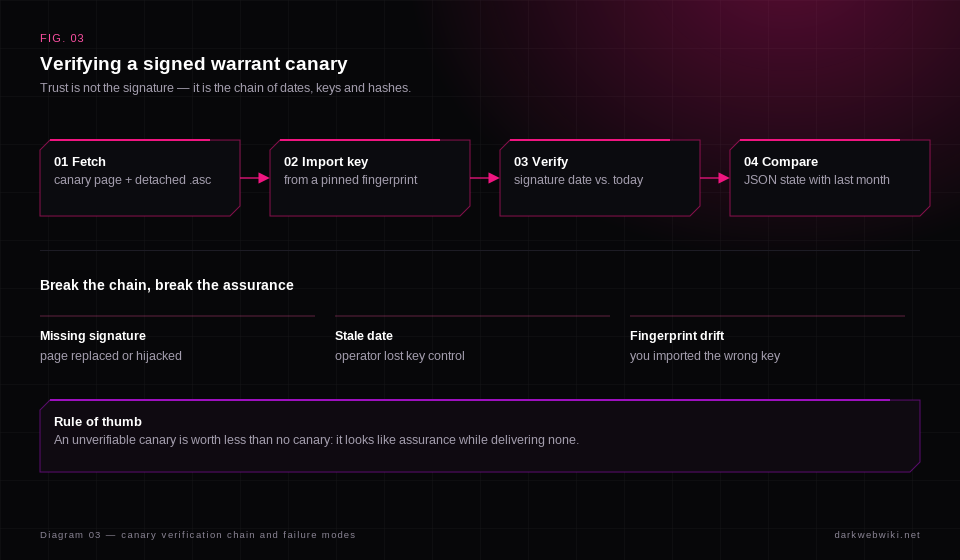
Four mirrors, region-tagged and canary-pinned, on a fixed cadence rather than only after incidents — the operator re-signs on the first of each month regardless. Three rails mean three deposit paths and three sets of confirmation rules to get right.
That is the cost: more surface, more to misread, and a buyer who assumes one rail everywhere will eventually pick the wrong one at checkout. The checkout's refusal of a mismatch is the mitigation, and it is a good one.
Mirror infrastructure
Four hosts, tagged by region inside the canary so a buyer can pick the nearest and least loaded. The canonical host is marked and the tags are part of the signed payload, so a clone cannot quietly re-tag itself as the closest mirror.
Region tagging is a genuine convenience and a mild risk: it invites trust in the label rather than in the string. Compare all 56 characters even on the nearest host.
Reception
Vendor reaction splits cleanly on the deadline scoring: welcomed by established vendors whose queues rarely slip, resented by those who treat a slow reply as an operational style. Buyer reaction is the more telling — dispute initiation is higher here than on specialty entries and closes faster, which together suggest the pipeline is being used rather than admired.
As a reference case, Catharsis is the entry that treats process as a first-class product, and the only one where a moderator's performance is externally measurable.
Questions
Which currency should be used?
The one matching the vendor's dispatch corridor; checkout refuses a mismatch.
Are dispute deadlines published?
Yes, including the first-response window, and moderators are publicly scored against it.
How often is the canary signed?
On the first of every month, regardless of incidents.
Can a vendor change dispatch country?
Only by re-listing at the new country's bond tier.
See also
- Torzon Market — three-rail breadth without the written pipeline
- Omega Market — the single-rail alternative with a flat fee schedule
- FAQ — what a dispute window protects