
Omega Market
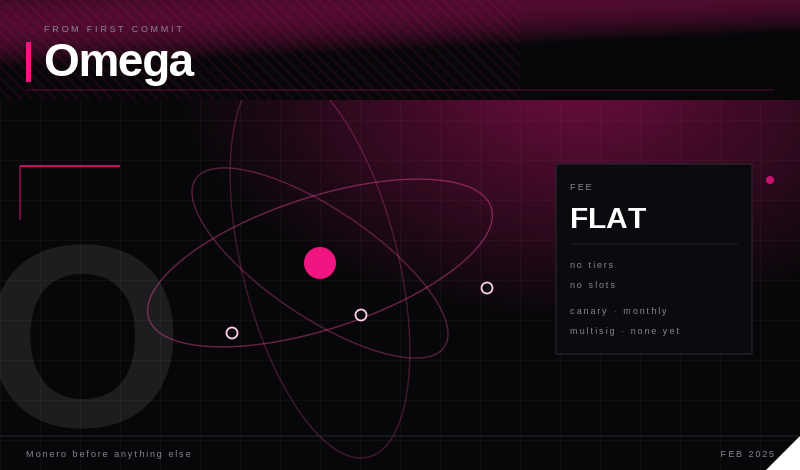
The newest entry and the only one that was Monero-native before it was anything else. No retrofitted rail, no tiered fees, a canary on a calendar and a mirror set small enough to audit. Short on history, unusually clean on structure.
Background
Omega opened in February 2025 and is the newest entry in this directory. Where older Monero-only platforms arrived at their single rail by subtraction — dropping Bitcoin after a seizure or a clustering scare — Omega never had another rail to drop. Monero is in the deposit flow, the multisig handshake and the vendor accounting from the first commit.
The result is a platform with no legacy seams: no half-migrated wallet code, no Bitcoin-era confirmation logic left in a corner, and no vendor documentation written for a rail that no longer exists.
History
Short. The platform launched with a flat fee schedule and a monthly canary, both of which read as statements about how the operator intends to be held to account rather than as conveniences. Two listing revisions and one mirror addition in its first year are the whole of the public change log.
Being new is the central limitation of this entry. There is no seizure history, no survived outage, no multi-year vendor cohort — only structure, and structure is easier to describe than to trust.
Design and interface
Server-rendered with light enhancement, single language, and a deliberately short navigation tree. Fees are displayed on every listing in absolute terms rather than as a percentage to be computed, which matters more than it sounds: percentage fees silently scale with order size and are the usual hiding place for tiering.
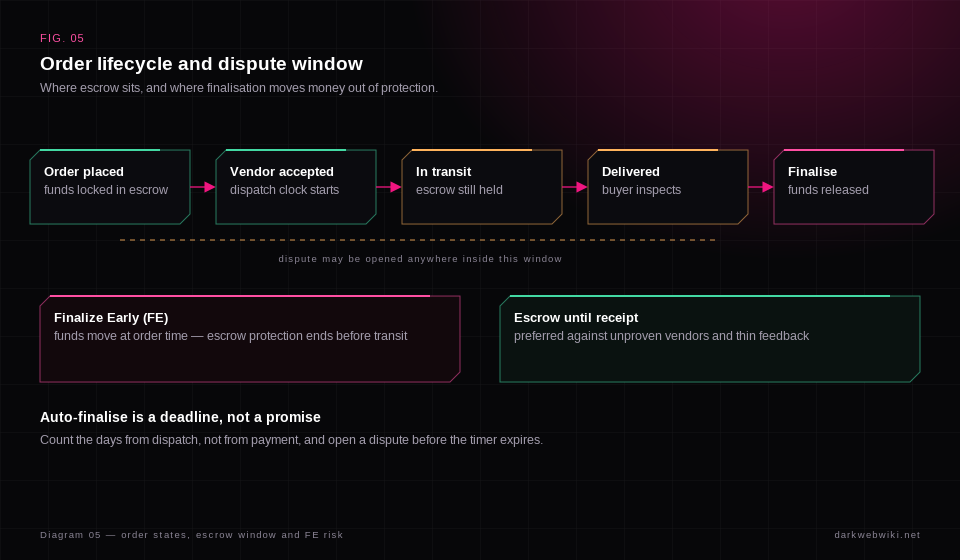
Finalize Early is tagged on listings in the vendor header rather than in the body text, where other platforms bury it. The tag is part of the sortable fields, so FE and non-FE vendors separate cleanly.
Payment and escrow
Monero only. Standard escrow, with FE vendors clearly tagged and sortable, and deposit addresses issued per order with two confirmations. There is no multisig option yet; the operator's roadmap places it after a stable year, which is the honest ordering for a handshake flow that support staff must be able to debug.
Because FE is tagged at the header, the practical advice is easy to apply: sort FE off for any vendor you have not used before. Mechanics are in the escrow reference.
Policy
The bond is flat and single-tier, which is unusual and slightly regressive — a small vendor pays the same as a large one. In exchange the fee schedule is flat too: no listing tiers, no promotion slots, no percentage cut that grows with basket size.
Prohibited lists follow the cohort norm. Disputes run on a standard window with two permitted extensions, and the moderator queue is small enough that response times in the first year stayed under the directory median.
Security model
Three mirrors, all documented in the canary, re-signed monthly on a fixed date. Monero-only settlement closes chain analysis without needing a policy to do it, and there is no scripting restriction — the browser class stays open and Safest degrades the interface.
The absence of multisig is the clearest gap: an exit scam here takes every escrow balance at once, with no quorum to fall back on. The flat fee schedule and monthly canary are partial compensation, not a substitute.
Mirror infrastructure
Three hosts, documented rather than rotated quietly, each carrying an issue date in the signed canary. The canonical host is marked and the payload is re-signed on the first of the month whether or not anything has changed.
Documenting mirrors instead of churning them is a small but real auditability gain: a reader can tell whether a host they saw last month still exists rather than guessing from its absence.
Reception
Early reception centres on the fee schedule — vendors like the flat structure and buyers like seeing absolute numbers — and on the missing multisig, which is the most common single criticism. Researchers have not yet covered it, unsurprising at this age.
As a reference entry Omega is the cleanest demonstration that Monero-native is an architectural fact rather than a marketing label, and the clearest illustration of what a platform looks like before it has been tested.
Questions
Does Omega offer multisig?
Not yet; it is on the roadmap after a stable first year.
How are fees structured?
Flat, with absolute amounts shown per listing rather than a percentage.
How is Finalize Early flagged?
In the vendor header and as a sortable field, not buried in listing text.
How often is the canary re-signed?
Monthly on a fixed date, regardless of incidents.
See also
- BlackOps Market — Monero-only with multisig and a longer record
- DrugHub Market — another Monero-only entry with a capped scope
- Catharsis Market — three rails and a published pipeline