
Torzon Market
The convenience counterweight in this directory. Torzon keeps Bitcoin on the rail and a mirror set large enough to absorb sustained attack — and then pays for both with a bigger phishing surface and a noisier dispute queue than any Monero-only entry.
Background
Torzon opened in 2022 and positioned itself from the start as a broad, dual-rail platform for a European and CIS-heavy audience. Where the Monero-only cohort treated convenience as the thing to trade away, Torzon treated it as the product: two settlement rails, a large mirror ring, and an interface that assumes JavaScript is available.
The result is the most conventional entry in this directory, and the most exposed. Almost every criticism that applies to it — phishing surface, dispute volume, chain-analysable deposits — follows from decisions taken deliberately rather than from neglect.
History
Growth came through Dread threads and cross-posting in vendor communities that already used Bitcoin rails and were unwilling to rebuild their accounting around Monero. Through 2023 the platform expanded its category list and its mirror count in step, and by 2024 was one of the larger Western-facing markets by registered vendors, though never by settlement volume.
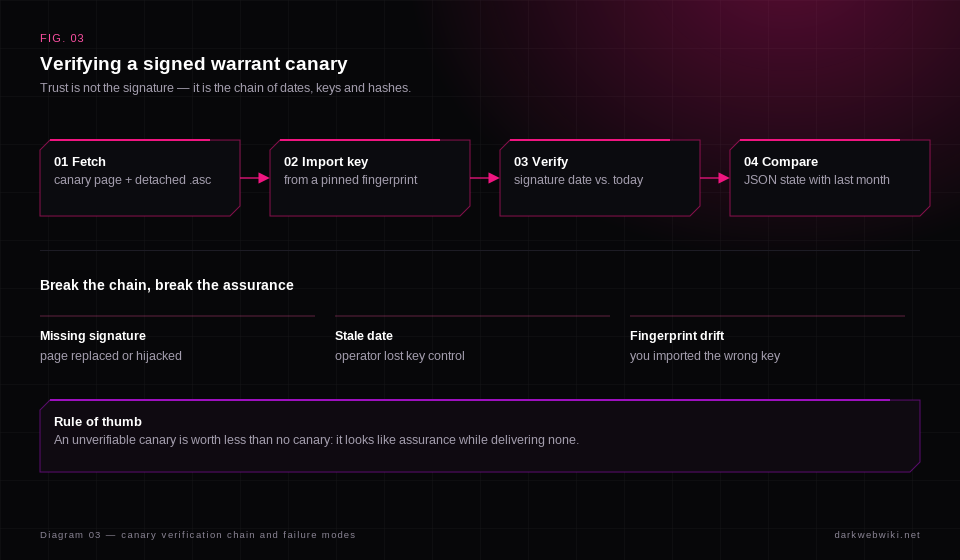
Two incidents in the 2023–2024 window set the tone for how the operator communicates: both were followed within days by a re-signed canary carrying an incident note, rather than by silence. That habit is worth more than the incidents cost — a canary that changes only on good news is a decoration.
Design and interface
The interface is a JavaScript single-page shell, keyboard-navigable and fast once loaded, with a cart, instant filters and live order state. On a low-bandwidth line or at Tor Browser's Safest level the shell degrades: Safest disables the script and leaves the reader with the initial payload and no filters.
The trade is explicit and the operator does not pretend otherwise. Torzon is the entry to recommend to someone who wants the 2019 experience of clicking through a catalogue, and the one to warn about if the reader intends to run Safest.
Payment and escrow
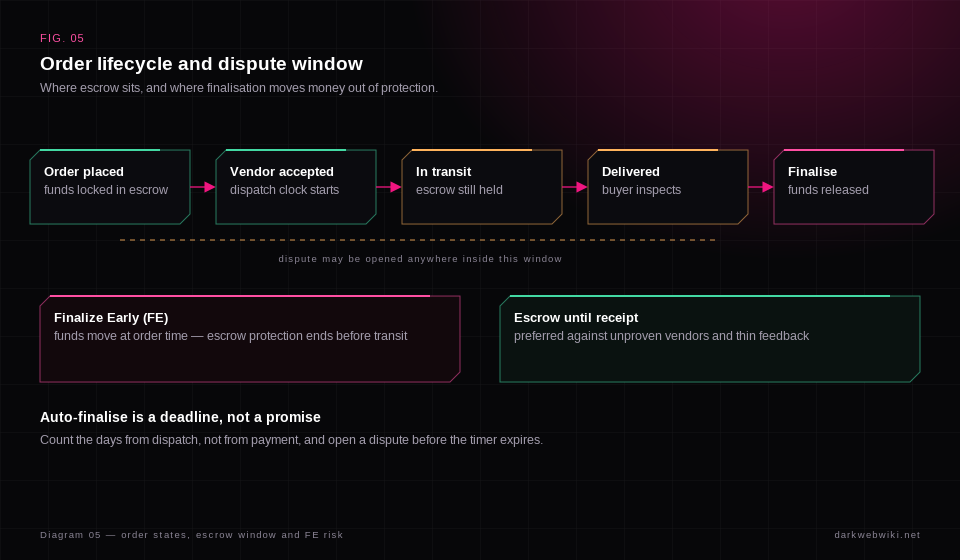
Both BTC and XMR settle, with escrow as the default and a 2-of-3 multisig option at checkout. The multisig implementation is shared-key-handshake based and works identically across both rails, though the Bitcoin variant is the older and more exercised path.
Bitcoin deposits are single-address and reusable, which is convenient and clusterable: reuse the same address across orders and every one of them becomes linked in a public graph. Monero deposits are per-order and carry two confirmations before credit. For the general mechanics see the escrow reference.
Policy
The bond is tiered: higher for categories with high chargeback pressure, lower for the long tail. Prohibited lists follow the cohort norm — firearms, services aimed at individuals, counterfeit medicine — with a permissive reading elsewhere; the category count is deliberately uncapped.
Most controversy in vendor discussion concerns the uncapped catalogue. A deep generalist scope means a buyer can complete an entire basket in one order, and it also means the moderator queue carries listings from categories with nothing in common. Median dispute resolution is measurably slower here than on any specialty entry in the directory.
Security model
Torzon's security posture is defensive breadth rather than technical restriction: many mirrors to survive outages, key pinning for vendors, and a canary that is re-signed after each incident. There is no equivalent of BlackOps's no-JavaScript rule, so the browser attack class stays open and the user has to close it by choosing Safest and accepting a degraded interface.
The mirror ring is both the strength and the liability. Load is spread, but the ring is large enough that most users encounter a mirror through a search result rather than through the canary — precisely the path a clone wants. Compare all 56 characters, every time.
Mirror infrastructure
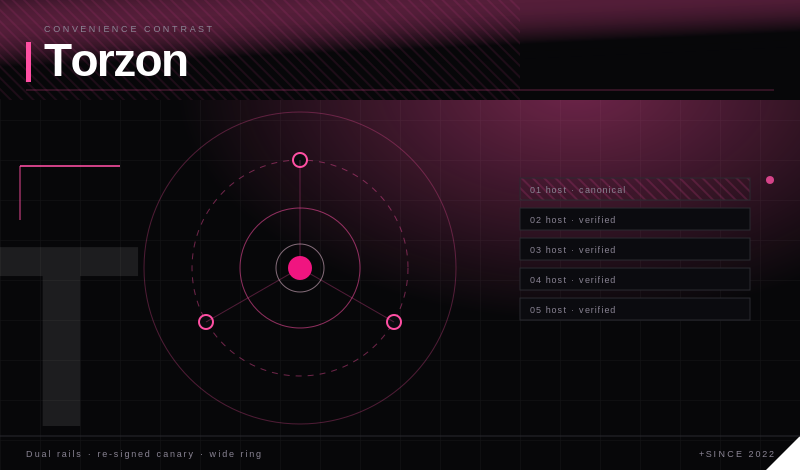
The ring runs to roughly a dozen hosts at any time, added and retired on rotation. Each host serves the same catalogue; the canonical host inside the canary is the reference point and the only one a clone cannot substitute.
Mirror churn is the main reason the address list on third-party sites goes stale, and stale lists are where clones win. On Torzon specifically, treat any mirror not present in the current signed canary as unverified no matter how many forum posts repeat it.
Reception
Vendor reception is broadly positive on throughput and negative on queue depth. Researchers cite it as the counterexample when arguing that Monero-only platforms are not the whole story: here is a market with real volume on a transparent rail, functioned by an operator who re-signs the canary on schedule.
For a reference work Torzon is indispensable as the contrast case — read it beside BlackOps and the cost of convenience, and the cost of restriction, both become concrete.
Questions
Which currencies does Torzon Market accept?
Bitcoin and Monero, both settled through escrow or an optional 2-of-3 multisig wallet.
How large is the mirror ring?
Around a dozen hosts on rotation; only the host inside the current signed canary should be trusted.
Does Torzon work without JavaScript?
Partially. The shell loads but filters and live state are unavailable at Tor Browser's Safest level.
Is Bitcoin deposit address reuse dangerous?
It links orders into a public graph, so a fresh address per order is preferable where the platform allows it.
See also
- BlackOps Market — the restricted-rail, no-JavaScript contrast
- Catharsis Market — three rails and a written dispute pipeline
- Omega Market — XMR-native without the mirror sprawl