
CannaExpress
Specialisation taken to a single category: cultivar-level listings, cure-date metadata and vendors who are growers rather than resellers. The narrowest inventory here and, because of it, the shortest and least ambiguous dispute tail.
Background
CannaExpress is the directory's single-category case. Everything on it is cannabis, described at cultivar level with cure date, grow method and batch number — metadata that a generalist market has nowhere to put and no moderator with the competence to check.
The premise is that a buyer comparing two grams on a generalist is comparing two product photos, while a buyer here is comparing two harvests. That difference is the entire product, and it justifies a catalogue of a few hundred listings where the generalists carry thousands.
History
The shop opened in the mid-2020s out of a vendor collective that had been trading inside the cannabis sections of larger markets. The first catalogue was copied wholesale from those sections, then pruned to the growers who could supply cure and batch metadata from their own records.
Growth has been flat and deliberate. There is no category expansion planned and no non-cannabis adjacency, which means the moderator roster has never needed to grow past the founding team.
Design and interface
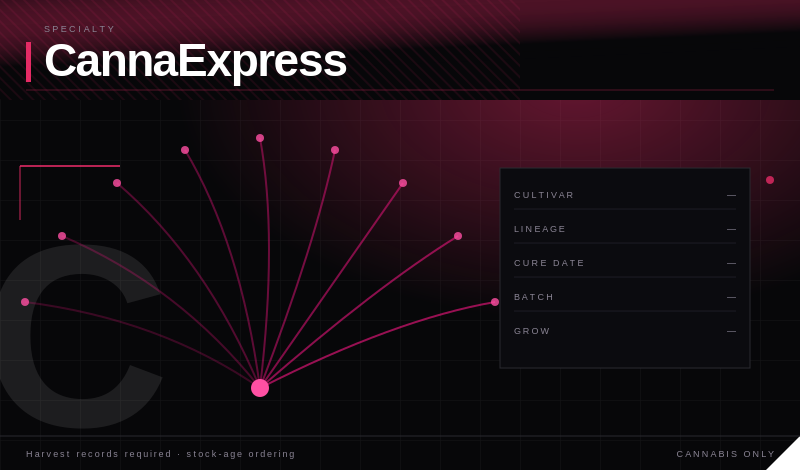
Server-rendered with light enhancement, organised as a strain index rather than a category tree. Each listing carries cultivar, lineage, cure date, batch size and a grow-method tag; filters operate on those fields, not on price alone.
The index is the whole interface. There is no front-page promotion slot to buy, so ordering in the list is by stock age — a six-week-old listing sinks whether or not the vendor is popular, which is a quietly effective anti-stagnation rule.
Payment and escrow
BTC and XMR both settle, through classical escrow, with multisig available on request rather than by threshold. Escrow windows are the shortest in the directory — typically three to seven days — because a domestic grower's parcel either arrives inside a week or has not been sent.
Short windows cut both ways: less time for a slow parcel to prove itself, less time for the buyer to act. Finalise only after inspection, and read the window on the listing rather than assuming the cohort default. General mechanics are in the escrow reference.
Policy
The bond is low and flat, because the barrier is metadata rather than capital: a vendor who cannot supply cure date and batch number is not admitted at all. That single gate does more filtering than a large bond would, since a reseller cannot invent a harvest record that survives a buyer's check.
Disputes are heavily weighted toward quantity and cure accuracy, which is a narrow enough question that most close inside three days on photographs. The prohibition list is short by construction — anything not cannabis is out.
Security model
A single category makes the security model unusually legible: fewer vendors, fewer listings, fewer moderators, two mirrors. There is no scripting restriction and no threshold multisig, so the posture is conventional — the narrowness is doing the work that technical restriction does elsewhere.
The concentrated risk is vendor identity. A collective of growers means a handful of accounts hold most of the catalogue, and a compromised key on one of them exposes a large share of the order flow at once.
Mirror infrastructure
Two mirrors, mirroring the flat growth of the catalogue. Both are listed in the signed canary and neither is distinguished as canonical beyond the marking, so the audit surface is minimal.
Because the set is tiny, a stale third-party list is more likely to be complete-and-wrong than short-and-wrong — the dangerous shape. Verify the signature, then read from the canary.
Reception
Buyers who care about provenance stay; buyers who want one basket across categories do not. Vendor-side commentary is warmest about the absence of a promotion slot, since visibility follows stock age rather than ad spend.
For a reference work the entry shows the far end of the specialisation axis — where the market's function is closer to a curated index than to a trading venue, and where that makes the dispute process nearly trivial.
Questions
What metadata does CannaExpress require?
Cultivar, lineage, cure date, batch size and grow method; a vendor without a harvest record is not admitted.
How long are escrow windows?
Typically three to seven days, the shortest in the directory, because domestic growers ship inside a week.
Is multisig available?
On request, rather than automatically above a threshold.
Are listings ordered by popularity?
No — by stock age, so older listings sink regardless of vendor rating.
See also
- DrugHub Market — specialisation by capped category list rather than a single category
- WeTheNorth — specialisation by geography
- Escrow & 2-of-3 multisig — the mechanics behind the short windows